Table of Contents
Ethical: Being ethical means conforming to accepted standards of conduct, making choices that align with moral principles of right and wrong, and treating others with fairness, honesty, and respect.
Ethical AI Use: Can It Be Responsible?
Can the use of AI be and responsible? I think living in a society with systems of implementation that focus on scale and disregard waste, it’s challenging to have responsible AI use. But I do think we can be conscious about how, why, when, and if we use it. I’ve been noodling on ethical and responsible AI use for awhile now, and while I don’t have a perfect answer, I’ve considered this very imperfect analogy (emphasis on very imperfect).
Understanding Ethical AI Use: The Food Industry Analogy
It reminds of how people choose to navigate the food industry. Vegans have ethical and environmental values that dictate their choices. Vegetarians may be similar but shifted for their own reasons (or may be shifting toward becoming vegan).
- There are conscious eaters who are in-between, whose aim is to eat less meat, focus on buying from farmers or CSAs, are aware of the impact on migrant farmers, or might even grow their own garden.
- There are the curious or flexible eaters, who have considered vegetarian and veganism but are overwhelmed. They might do meatless Monday’s as a way to test and shift how they prepare meals. They work toward reducing meat consumption or environmentally friendly ways of eating.
- You also have the meat and potatoes eaters who eat anything, everything, and might not hold those considerations. Access, income, where folks live, awareness, capacity, and other structures can determine how a person shifts their views and practices.
This is similar for AI users. The interconnection I see is that the food industry built a complex system, an infrastructure, that causes harm that we have to navigate (we have to eat). I realize that people do not have to use AI so the analogy falls short, but if you’re in the space of not wanting to use AI, even consideration of what browser to use becomes a choice. You have to consider what settings you turn on and off in your email. Companies use the opt-out feature because they know people forget and don’t pay attention. The question, for some, isn’t as simple as “Do I use AI?”
Defining Your Values for Ethical AI Use
In the systems that are built for consumption, responsible AI use comes in understanding the system, understanding your own values, and narrowing down the choices you can make that align with those values. Returning to the food system analogy, consumption might align with values, life / work events and stressors, access, quality, and capacity. This is about reflecting to come to the answer that is best for you.
How to Use AI Ethically: My Framework for Responsible AI
The way we apply values for our personal use and organizations will differ in practice, simply because of scale. An organization might develop a policy, standard operation procedures, and use structures to align their policies. Individuals might consider personal purchases, workflows, and personal settings.
For Brilliant Patterns, my personal use and organizational use fall more in the conscious & flexible AI user, and as I refine, I develop better workflows or use cases for where I want to use AI. I move in-between each “tier” as I learn more and refine my AI use.
Ideally, I want to build something that uses AI to solve a particular problem, along with other supports that do not use technology. Right now, I’m working on practicing better workflows as I learn where I get stuck in prompting. I’m not fully there yet, but here are some values I’ve defined for myself and choices I am making. I plan to create a series of posts that goes through each of these values separately, how I apply my values, and reflections to help others think through their own AI use and implementation.
My Values for Responsible AI Use
Problem Identification: Conscious Design & Decision-Making in Ethical AI Use. I get clear on what problem I’m actually trying to solve. Experimentation has taught me that even clear prompting often requires re-prompting, and sometimes talking to a person gives better solutions. I’m shifting away from defaulting to AI and instead asking: Why am I choosing AI for this problem? How do I build guardrails or better UX so that the problem I’m trying to solve becomes clearer.
Harm Reduction: What communities might this harm? In what ways? How do I mitigate it?
Environmental Efficiency. Data centers use massive amounts of water and energy. The problem isn’t individual AI use, it’s systemic scale. But I can still make conscious choices. How might I limit AI calls, improve my workflow to reduce inefficiency, and support companies working through environmental impact.
Data Retention, Privacy & Security. What data am I comfortable sharing with AI? What about communities or clients? This includes where data is stored or hosted, what models companies use and their practices, and whether to build/host my own model.
Innovative & Creative Friction: Building Responsible AI Practices. Many people use AI for speed. The emotional relief of offloading a problem instantly. But “friction” drives creativity and innovation. That mindful pause is something that is being engineered out of our life. I intentionally include pause: walks when I get stuck writing, conversations with people, sitting with problems before prompting. How might I build infrastructure that supports or aide this process?
Critical Thinking & Human Evaluation. How might I design infrastructure to support human evaluation and decision-making into AI use?
Access & Accessibility: Making Ethical AI Use Inclusive. What access does this AI tool enable? Who benefits? Who might be excluded? What security or privacy risks emerge when I consider who is using this? In my newsletter (reposted to my blog), I tested a version that included talk-to-text after seeing my mom interact with her phone while on vacation.
Trust: Transparency in AI Use. Trust depends on transparency about AI. How might I what to put or not put into AI?
Community & Connection: Preserving Human Interaction. How can AI be built as a support tool without replacing human connection? How do I build and collaborate with communities intentionally?
Accessible AI Literacy: As an instructional designer, I understand that accessibility and readability shape how people engage with information. The ability to critically evaluate and assess accuracy are gaps that already exist, and these challenges are accelerated by AI, especially when outputs sound authoritative and checks (source review, cross-referencing) are not built into the process. Designing supports, guardrails, and alternatives, including choosing not to use AI, help with this gap.
All of these values and practices are embedded into how I’m building (technological systems, human systems, and workflow) and will expand upon in subsequent blog posts.
Exercise: Define Your Ethical AI Use Values
Defining how and when you use AI will be an iterative experience. I believe that you have to start somewhere, implement a little, and learn from that. I started off a bit messy and am continuously iterating on how I guide myself in AI use – both through experimentation and connecting with people.
If you’re a person or organization grappling with AI use, here are questions to journal.
- What are my concerns and fears with AI use?
- Why do you have those fears? What have you seen in your community or work that brings those on?
- What are some core beliefs that come up about how you do your work? This could be workflow, what’s needed, what people might struggle with, etc.
Share these with a trusted person and have them reflect back what they’re hearing. Consider how those values might show up in implementation.
I believe the best way to decide if or how you want to use AI is to use it – to learn through doing and making your own guardrails about how you want to use it. To see where it does well, where it doesn’t.
How to Use AI Ethically: Turn Your Values Into Action
I value problem identification by getting clear on what problem I’m actually trying to solve, whether AI is the right tool, and how it might help or harm the people involved. Sometimes this clarity only comes through using AI and reflecting on what happens.
So I built a custom GPT to help you turn your values into action <> Use the free custom GPT to explore your AI ethics concerns and clarify what matters to you. The GPT helps you surface your underlying values through conversation.
Note: I have a love-hate relationship with Substack. Many of the features are only turned on when you have paid subscribers switched on. For example, I don’t get access to SEO control right now and I can’t send a post as e-mail to free subscribers. Because of this, I decided to move my long-form content to my blog and use Substack for something else. The custom GPT is in a “paid-only” post that can be accessed as a “teaser” as for free subscribers (just claim the post). This is my only paid post. I wanted a place to host resources for free subscribers and where I can easily update links. When I update the resource page, I’ll share with free subscribers.
This GPT is a starting point for brainstorming. I encourage you to deepen your thinking through research and conversations with your team.
Results from Ethical AI Use Custom GPT
I’ve tried this a few times, in different LLMs, to see differences in output.
Results from ChatGPT
| Values | Systemic & Individual Questions to Ask Yourself | Policies to Consider | Workflow to Consider | Examples |
|---|---|---|---|---|
| Privacy & Protection | Systemic: What data practices are built into the tools being considered? Who owns, stores, and can access data? Individual: Am I entering information I would not be comfortable disclosing publicly? | No personally identifying or sensitive community data in public AI systems; data minimization; informed consent requirements | Create a “red/yellow/green” data classification before AI use | Green: brainstorming workshop activities. Red: case notes, participant stories, internal vulnerability assessments |
| Trust & Verification | Systemic: Does the organization have verification expectations? Individual: Am I treating this as a draft to interrogate or an answer to accept? | Human review required for all externally-facing or high-impact outputs | Require fact-check / source-check / contextual review before use | AI drafts outreach framework, human verifies accuracy and appropriateness |
| Human-Centered Care | Systemic: Where would automation displace relational labor? Individual: Is AI replacing a conversation that should happen between people? | Define “human-only” zones of work | Add a decision checkpoint: “Should this be human-led instead?” | Strategy synthesis = maybe AI-supported; participant support conversations = human-only |
| Deliberate Pace (“Slow to go fast”) | Systemic: Is urgency real, or structurally imposed? Individual: Am I using AI to avoid sitting with complexity? | Reflection pause before deployment of new AI workflows | Add intentional review time after AI outputs | Use AI to generate options, then pause before selecting direction |
| Community-Building over Efficiency | Systemic: Does this tool strengthen collective capacity or isolate people into tool dependence? Individual: Does this use help people think together? | Evaluate tools on relational impact, not just productivity metrics | Use AI for prep/admin support, then use saved time for dialogue and co-design | AI summarizes themes from prior notes, team uses that time for deeper collaborative discussion |
| Creative Friction | Systemic: What forms of productive struggle are worth preserving? Individual: Am I outsourcing the thinking process too early? | Use AI after first-pass human ideation | Start with independent reflection before prompting | Draft framework yourself first, then use AI to stress-test or expand it |
Claude (Without my frameworks):
| Value | Systemic Questions to Ask | Individual/Workflow Questions to Ask | Policies to Consider | Workflow to Consider | Examples |
|---|---|---|---|---|---|
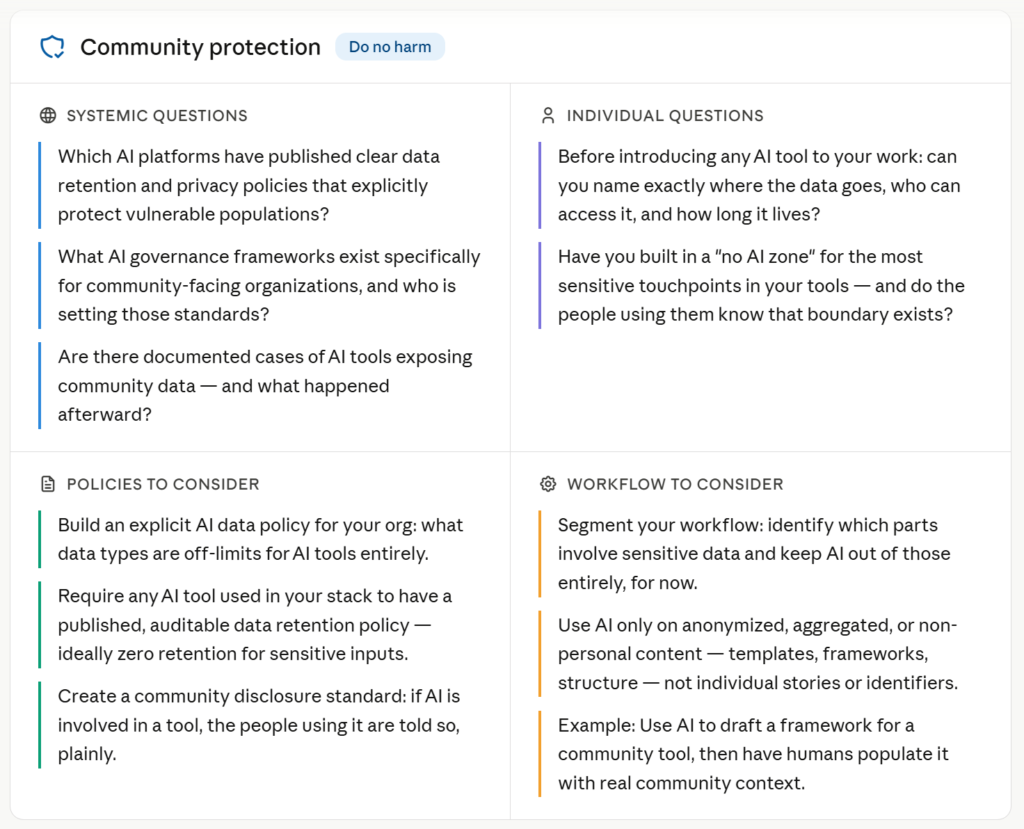
| Protection & Care | Which AI companies have published responsible AI frameworks specifically addressing vulnerable populations? How are AI tools being regulated in social services or nonprofit contexts? | When I introduce an AI tool to an org, have I mapped out every place their clients’ data could travel? Have I done a harm assessment before deployment, not after? | Data processing agreements with AI vendors. No AI tools that train on user data by default. Client-facing tools require explicit informed consent language. | Build a pre-deployment checklist: Who is the data about? Where does it go? What’s the worst case? Who bears the harm if it goes wrong? | Before recommending any AI tool to a nonprofit, run it through a “vulnerable population impact screen” — a short set of questions you design and own |
| Accountability & Truth | Which AI tools have the most transparent sourcing and hallucination mitigation? How are organizations in your sector building human review into AI workflows? | When was the last time I verified an AI output before passing it along? Do the orgs I build for have a culture of questioning AI, or are they likely to trust it uncritically? | Require human review checkpoints for any AI-generated content used in client-facing work. Build “AI was used here” disclosure into deliverables. | Create a simple verification habit: every AI output gets one check against a primary source before it moves forward. Make this a team norm, not just a personal one. | A case notes tool that flags AI-generated suggestions as “draft only — verify before use” |
| Data Sovereignty | Which AI platforms offer private deployment or on-premise options for sensitive orgs? How are indigenous, BIPOC, or other historically targeted communities building their own data governance frameworks? | Am I using AI tools that train on the data I input? Have I read the terms of service of every tool I’m recommending to orgs? Do the communities I serve know what happens to their data? | Default to AI tools with zero data retention policies for sensitive work. Advocate for org-level AI use policies that center community data rights. | Maintain a “trusted tools” list — vetted for data practices — that you update regularly and share with the orgs you support | Recommending tools like local LLMs or privacy-first platforms for orgs working with undocumented communities or survivors |
| Intentional Pace | How are funders in your sector starting to address the pressure they create for fast, AI-driven deliverables? Are there coalitions pushing back on “efficiency” as the primary metric for community work? | Am I using AI because I genuinely need it right now, or because I feel pressure to move faster than the work requires? When I use AI to speed something up, what am I skipping — and does that matter? | Build “pace agreements” into project scopes — explicit language with funders and orgs about why slow process produces better outcomes | Before starting any AI-assisted task, write one sentence: what problem am I actually solving? This slows the reflex to just prompt and go | Reframing a grant deliverable timeline with a funder to protect community engagement depth — and documenting why |
| Productive Friction | Are there researchers or practitioners documenting what gets lost when AI removes friction from community processes? How are organizations measuring relational outcomes, not just efficiency? | Have I ever used AI to skip a conversation that actually needed to happen? Are there places in my workflow where the “hard part” is actually the most important part? | Design AI-free zones into community processes intentionally — not as a rejection of technology but as a protection of relational space | Map your workflow and mark which steps should stay slow and human. Use AI only in the steps where speed doesn’t cost anything relationally | A community needs assessment where the conversations are the data — AI can help analyze afterward, but not replace the gathering |
| Technology Serving Connection | Which organizations are using AI in ways that visibly strengthen community rather than extract from it? What does ethical tech look like in movement or advocacy spaces? | When I deploy a tool, do I check back — does this feel like it’s bringing people together or creating distance? Am I building with communities or for them? | Require community input in tool design, not just tool rollout. Build feedback loops so communities can say “this isn’t working for us” | Co-design sessions before building — bring the people who will use the tool into the problem definition, not just the solution | A data dashboard built with a community org where they defined what metrics mattered to them — not what was easiest to track |
| Lived Accountability | How are other builders who are also community members navigating the dual role — insider knowledge + insider stakes? Where are those conversations happening? | Am I making decisions as a builder that I would be comfortable with as a community member? When those two roles are in tension, which one wins — and should it? | Personal policy: before deploying anything, ask “would I be okay if this were used on my community?” If no — redesign. | Build a personal reflection practice around your dual role. Even a brief journal note after a major build decision can surface tension before it becomes harm | Sharing your own navigation openly with the orgs you support — modeling what thoughtful, values-aligned AI use looks like in practice |
Here is an another example from Claude <> Different settings / Frameworks