Executive Summary
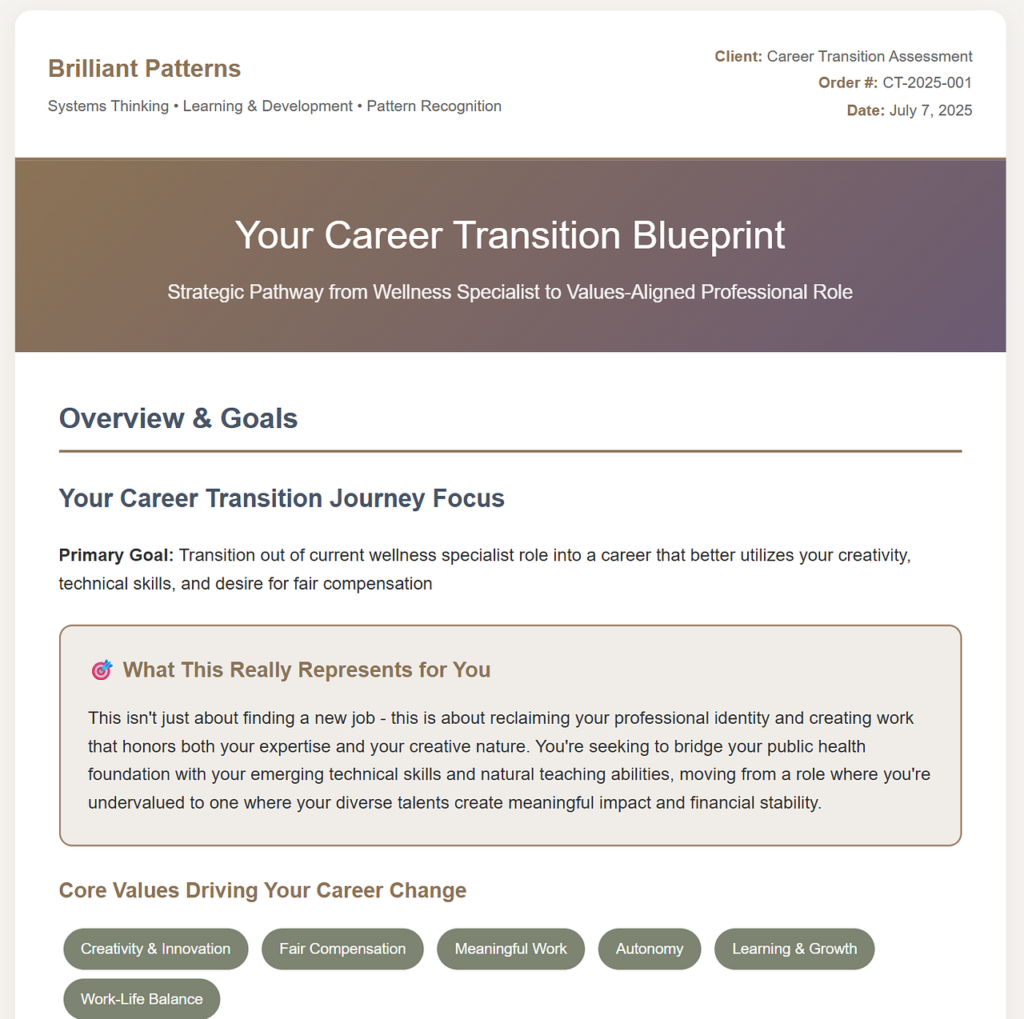
This career transition case study demonstrates how structured career assessment can accelerate professional change. Rather than a 12-month career transition filled with false starts, a career transition blueprint would have identified the optimal path in weeks.
The Real Challenge: A wellness professional experienced career stagnation and financial stress while working in a traditional wellness organization, requiring strategic guidance to address the mismatch between her creative capabilities and coordination-focused role demands.
What Actually Happened: It took 12 months of scattered efforts, multiple false starts in role exploration, and significant stress to successfully transition to an instructional design role.
The Retrospective Analysis: The Personal Pattern Blueprint assessment would have identified her optimal path from the start, with the potential to reduce this timeline to 3–4 months while eliminating unsuccessful and stressful dead ends.
Study Validation: Her successful transition used the same strategies the blueprint would have recommended, proving the methodology’s accuracy through real-world results.
The Actual Journey: 12 Months of Trial and Error
Phase 1: The Blind Career Transition Period (Months 1–6)
What Actually Happened:
- Spent months researching public health roles she was underqualified for and that did not fully align with her strengths (policy analysis, epidemiology)
- Explored education paths requiring extensive certification (transition to become a PE or Health teacher, dietitian, nursing → nurse educator)
- Received well-meaning but misaligned advice from people already in those fields
- Rejected nursing path despite advice, knowing she didn’t want to spend 3–4 years of bedside nursing to become a nurse educator (this might have led her to be stuck in another misaligned role)
The Hidden Costs:
- Months of emotional energy spent on dead-end research and job applications
- Increased stress from staying in misaligned current role
- Financial pressure continuing while exploring unsuitable options
- Self-doubt about career direction and abilities
The Root Problem: Looking for roles based on her existing field (public health/wellness) rather than her actual strengths and interests (teaching, creativity, program design).
Phase 2: The Creative-Discovery Period (Months 6–9)
What Actually Happened:
- Used multiple assessment tools (StrengthsFinder, Myers-Briggs, etc.)
- Created visual journals to identify likes, dislikes, and patterns
- Utilized O*Net and career exploration tools
- Began informational interviews with various professionals
- Discovered public health instructional design through networking
The Insight: An informational interview with someone in public health instructional design finally aligned her health background with her love of teaching and program creation.
Phase 3: The Scattered-Insight Period (Months 6–12)
What Actually Happened:
- Leveraged existing partnerships to secure professional development scholarship ($1000+)
- Completed ATD instructional design certification
- Attended facilitation training with ToPs methodology (this supported her role and her understanding about what she enjoyed about facilitation)
- Completed graphic recording training with Bikablo (continued to support her understanding about what she enjoyed in facilitation. This translated into her journaling about her strengths, likes, dislikes, etc.)
- Applied strategic networking to land role with the organization where she’d done informational interviews
The Success: Landed instructional design position that utilized her public health expertise, training development, and creative skills.
Retrospective Analysis: What the Blueprint Would Have Changed
This career transition case study reveals a critical insight: professionals often
discover their optimal path through trial-and-error rather than strategic planning.
The career transition strategies identified in this case study were eventually
implemented, but only after 6 months of exploration. A structured career transition
framework would have accelerated this process dramatically.
Immediate Strategic Clarity (Week 1)
Instead of 6 months of confusion, the assessment would have immediately identified:
✅ Strategy 2: Corporate Learning & Development Pivot as the primary pathway
- Her love of “creating trainings for adults” and “teaching portion”
- Frustration with coordination vs. creation
- Natural gravitation toward “coaching or teaching others”

✅ Strategy 5: Strategic Network Leveraging as the implementation method
- Existing partnerships as key leverage point
- Professional development funding opportunities
- Structured approach to informational interviews

Avoided Detours (Months 1–6)
The Personal Pattern Blueprint would have immediately ruled out:
- ❌ Staying within traditional public health roles (policy, epidemiology)
- ❌ Pursuing new certifications requiring years of training
- ❌ Exploring fields that didn’t match her creative strengths
Instead, focusing energy on:
- ✅ Translating existing training experience into L&D language
- ✅ Building portfolio of instructional design work
- ✅ Targeted networking in learning and development field
Structured Skill Development Plan (Months 2–4)
Rather than discovering training needs through trial and error:
- Month 2: Portfolio development showcasing existing training programs
- Month 3: ATD certification (already funded through Kaiser partnership)
- Month 4: Advanced facilitation and design skills training
Personalized Implementation (Ongoing)
The Personal Pattern Blueprint’s tracking system would have provided:
- Clear daily actions instead of overwhelming “figure out your career”
- Energy management strategies for job searching while employed
- Structured approach to relationship building and follow-up
Career Transition Timeline Comparison: Reality vs. Blueprint

ROI Analysis: The Hidden Costs of Trial-and-Error
The hidden costs of unstructured career transition exploration are significant.
This career transition case study quantifies the time, money, and stress savings
that strategic assessment provides.
Time Investment
- Actual: 12 months of career uncertainty
- Blueprint: 3–4 months to successful transition
- Savings: 8–9 months of productive time
Financial Impact
- Actual: 12 months of below-market compensation while searching
- Blueprint: 8–9 months earlier access to higher-paying role
- Potential Income Gain: $20,000-$30,000
Stress and Well-being
- Actual: Extended period of job dissatisfaction, financial stress, and career uncertainty
- Blueprint: Clear pathway with measurable progress and defined timeline
- Value: Reduced anxiety, better work-life balance, clearer sense of professional identity
Professional Development ROI
- Actual: $1000+ Kaiser scholarship used effectively, but after 6 months of uncertainty
- Blueprint: Same funding deployed strategically from month 2, maximizing impact
Key Success Factors That Aligned
What She Did Right (Blueprint Validation)
- Leveraged Existing Relationships: Used existing partnerships strategically — exactly what Strategy 5 recommends
- Focused on Strengths: Eventually identified learning and development as core interests — central to Strategy 2
- Invested in Relevant Skills: ATD certification, facilitation training, and graphic recording all aligned with L&D career path
- Strategic Networking: Informational interviews led directly to job opportunity — key component of blueprint approach
- Creative Problem-Solving: Visual journaling and recognition of her own skills & interests demonstrated the complex problem-solving the blueprint leverages
The Difference: Structure vs. Discovery
- Her approach: Trial-and-error discovery through multiple tools and conversations
- Blueprint approach: Immediate recognition leading to targeted action
- Both reached the same destination, but the blueprint eliminates the 6 months of false starts and provides clear implementation steps.
Retrospective Reflections
“It’s interesting looking back at what I was trying. When I think about it, I went the policy analysis route because I liked strategic thinking, but there’s tons of bureaucracy that would have stunted creativity (or it may have enabled it, but it was not the creativity that I tend to gravitate to). It might have also posed challenges with the type of work I like to do. I honestly stumbled on instructional design (there’s even a book called “The Accidental Instructional Designer” that I picked up). I think with all the reflection I was doing at the time, this report would have pointed me in the right direction sooner (though I learned a lot along the way).”
Career Transition Blueprint Validation: Strategy Accuracy
The professional’s successful transition validates the blueprint’s strategic framework:
Primary Strategy Confirmed: L&D Pivot (Strategy 2)
- ✅ Utilized teaching abilities and program creation skills
- ✅ Moved away from coordination-heavy wellness work
- ✅ Achieved better compensation and career advancement
- ✅ Found creative fulfillment in instructional design
Implementation Method Confirmed: Network Leveraging (Strategy 5)
- ✅ Kaiser relationships provided professional development funding
- ✅ Informational interviews led directly to job opportunity
- ✅ Existing partnerships accelerated transition process
Avoided Pitfalls the Blueprint Would Have Prevented:
- ✅ No time wasted on misaligned traditional public health roles
- ✅ No pursuit of unnecessary certifications
- ✅ No extended period of career confusion
The Blueprint Advantage: Prevention vs. Correction
What the Assessment Prevents:
- Months of exploring misaligned career paths
- Investment in unnecessary certifications or training
- Extended periods of career uncertainty and financial stress
- Scattered networking without strategic focus
What the Assessment Provides:
- Immediate clarity on optimal career direction
- Structured implementation plan with clear milestones
- Strategic leverage of existing relationships and strengths
Conclusion: Retrospective Validation of Strategic Assessment
This career transition case study demonstrates that while professionals can
eventually navigate career transitions successfully, strategic assessment and
structured career transition planning dramatically accelerate the process.
This professional succeeded because she:
- Eventually identified her true strengths and interests
- Leveraged existing professional relationships strategically
- Invested in relevant skill development
- Used informational interviews effectively
The Personal Pattern Blueprint would have:
- Identified these same strategies immediately
- Provided structured implementation steps
- Eliminated months of false starts, dead ends, and confusion
- Reduced stress and accelerated timeline by 8–9 months
Key Takeaway: This real-world success story validates our assessment methodology — she eventually chose exactly the strategies the blueprint would have recommended from day one, proving that strategic career assessment can identify optimal paths accurately while dramatically accelerating implementation.
Methodology Note
This case study is based on the real career transition experience of a wellness professional who successfully moved into instructional design between 2017–2019. Timelines, strategies, and outcomes are factual, though as noted, some of these efforts were scattered and not linear. The “blueprint alternative” analysis is a retrospective assessment showing how our structured approach would have guided her to the same successful outcome in 75% less time, based on the responses she would have given to our career transition assessment during that period.
Ready to accelerate your career transition? The Personal Pattern Blueprint
provides the strategic clarity this professional eventually found—but in weeks
instead of months. Learn how career transition assessment can identify your
optimal path and eliminate months of uncertainty.
This has be cross-posted on brilliantpatterns.co and Substack for reach.