A case study on how AI improved interview confidence in a competitive market
Table of Contents
Executive Summary
Using a personalized approach, she secured a competitive healthcare administration fellowship within 1 month (beating her original 6-month timeline).
The Core Issue: Why Healthcare Administration Fellowship Success Requires Strategy:
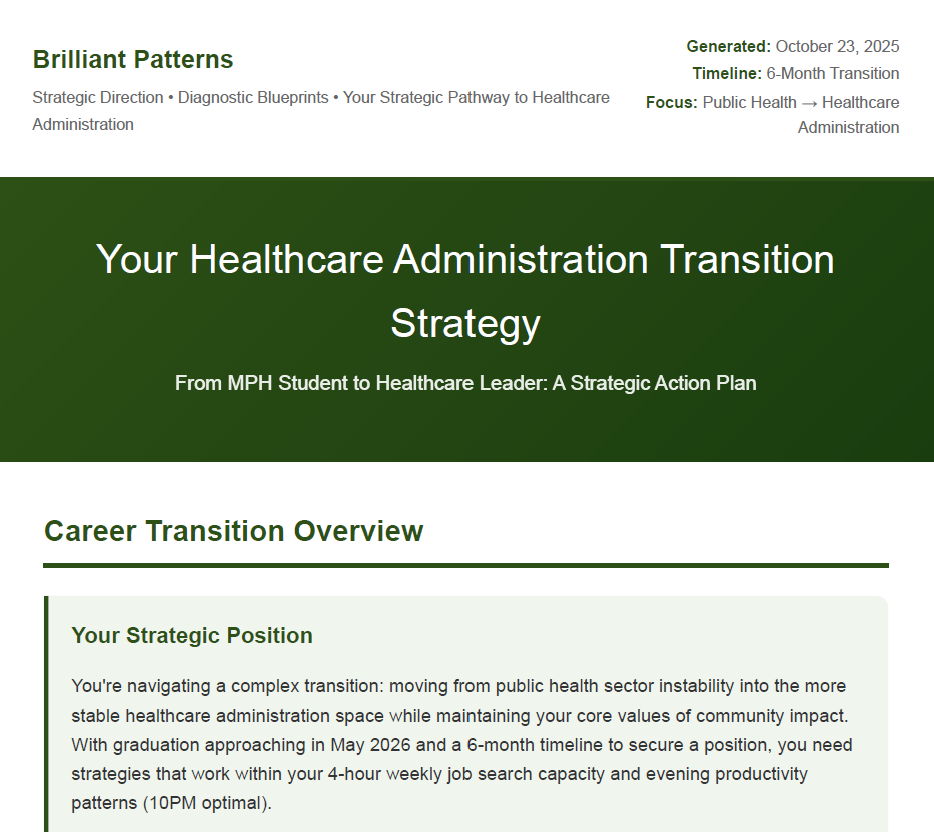
A Master’s of Public Health (MPH) candidate with a focus in Health Systems, Management, & Policy (HSMP) and a 4.0 GPA struggled with interview confidence. She was hoping to pivot from public health (career instability, lower pay) to healthcare administration (more stable, higher pay). Her strategy started as “I have been applying to administrative fellowships (with not much luck so far) but am leaning towards finding a new job or role for me once I graduate.” In this process, she did not feel fully prepared for interviewing beyond practicing interview questions.
Understanding the Career Transition: From Public Health to Healthcare Administration Fellowship
If you are unfamiliar with health systems, management, & policy or healthcare administration, here is an analogy to help with differentiation:
- HSMP is like planning the whole school district. It’s similar to deciding bus routes, lunch programs, and safety rules for all students. Skills needed include:
- Big-picture thinking
- Policy & planning skills
- Data analysis
- Problem-solving
- Communication & collaboration
- Healthcare Administration is like being the principal of one school. Think: managing teachers, schedules, and daily operations. Skills needed include:
- Leadership
- Organization & operations
- People management
- Financial skills
- Crisis handling
It’s planning versus management.
Her Goals: In taking the assessment, she wanted to see if there were any tips, tricks, or guidance in preparing for the interview process.
This student was incredibly qualified and faced barriers such as:
- Interview Confidence Gap: Self-identified as “not great with interviews —especially in terms of confidence”
- Competitive Market: Administrative fellowships receive hundreds of applications for a few positions
- Time Constraints: Only 4 hours weekly available for job search while managing full-time school and multiple part-time positions
- Evening-Only Productivity: Identified peak productivity at 10PM
- Skills Perception Gap: Believed financial analysis skills were insufficient for healthcare administration roles
- Sector Transition Complexity: Moving from public health (unstable, lower-paid) to healthcare administration (stable, higher-paid) while maintaining mission alignment
- Seeking financial Independence: Hoping to move out of her family’s home soon
The Solution: How to Prepare for a Healthcare Administration Fellowship Interview
After completing the career strategy blueprint, she received five implementation strategies. Below are the top 2 that she implemented:
Strategy 1: The Evening Interview Lab for Healthcare Administration Fellowship Candidates
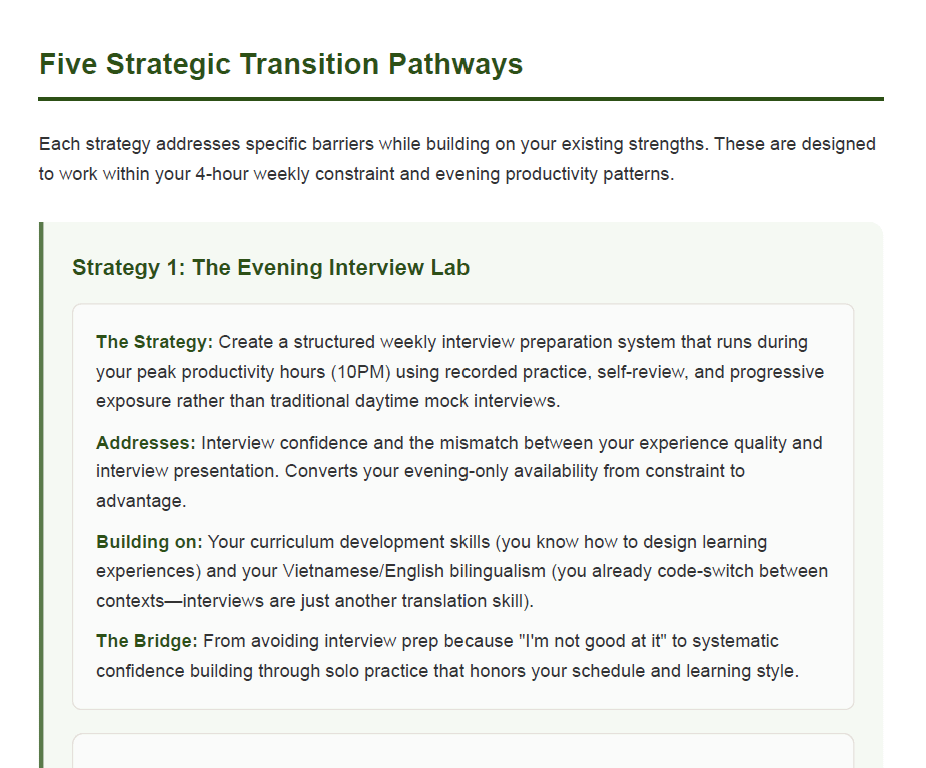
The Framework: A solo practice system designed for evening productivity, eliminating scheduling barriers
What It Provided:
- Structure for when to practice and how to practice
- Week-by-week implementation steps
- Solo-executable (no appointment coordination needed)
- Progressive exposure from low-stakes recording to high-stakes interviews
What She Learned:
“It helped by creating structure for interviews; I thought it was just practicing some questions. There was also an emphasis on confidence. It gave guidelines, gave questions to try out and practice, and was very tailored.”
What Made It Work:
“I liked how it guided me through a structure to prepare for my interviews and outlined important skills I need to build as I go into the fellowship interview season. It outlined times where I should practice, and how I should practice, which has been very helpful. It gave me more discipline and ideas on how to improve my interview skills.”
Strategy 4: Healthcare Continuum Narrative Architecture for Fellowship Applications
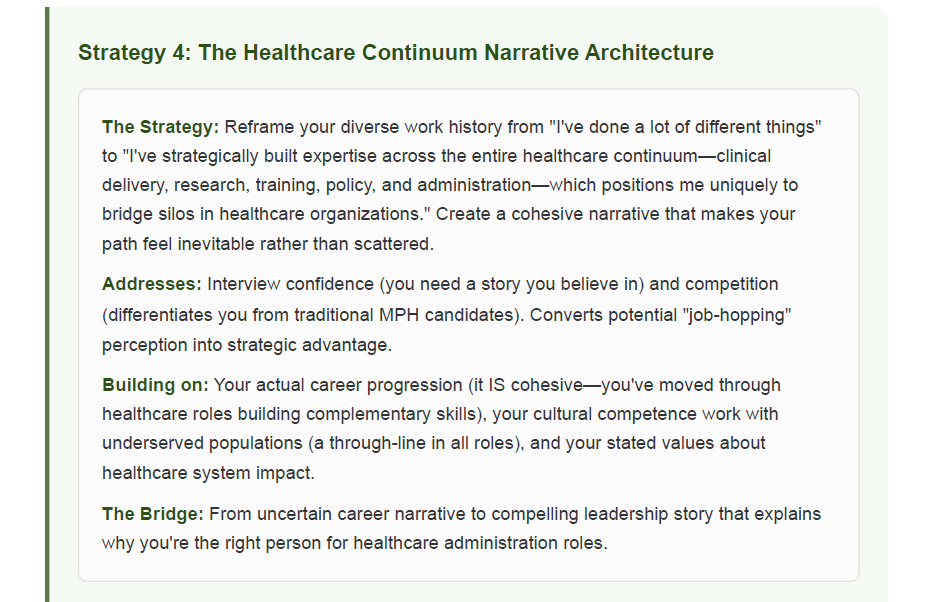
The Framework: A method for mapping her diverse experience into a cohesive story that positioned her background as a strategic advantage.
What It Provided:
- Framework for connecting clinical → research → training → administration roles
- A short narrative explaining why her path made sense
- Story that transformed “scattered background” into “strategic preparation”
What She Learned:
“I also did strategy #4 healthcare continuum narrative architecture. It helped me map my story and made it cohesive.”
What Made It Work:
“I really like how it is tailored to the individual while also considering challenges/barriers. Usually with other resources, they’re often very “general” and do not address individual limitations, challenges, and goals. As someone who needs to know what to do and when to do it, I am grateful for the implementation steps and timeline, too. It was very detailed and aligned with my needs.”
Measured Outcomes: Healthcare Administration Fellowship Success in 30 Days
Primary Outcome: Fellowship Success
- Time saved: 3-4 hours
- Secured competitive healthcare administration fellowship 🥳
- Outcome achieved within 1-month (had a 6-month timeline)
Process Outcomes:
- Confidence Increase: “Somewhat increased” confidence reported
- Implementation Rate: “Most/all recommendations” implemented
- Time Efficiency: 3-4 hours saved compared to alternative approaches
- Structured Preparation: “Very detailed and aligned with my needs”
- Interview Readiness: Created systematic practice framework where none existed
Follow-Up
In a follow-up interview, I asked what she would have done instead if she did not receive the blueprint.
Student’s Alternative Approach:
“Role searching about what should I do and using ChatGPT to get more clarity. Even with ChatGPT, it’s hard to just drop something in the chat to help guide me. This saved a lot of time.”
Critical Insight: The student noted that she would have needed:
- Multiple career services appointments, potentially with 2-3 week waiting periods for schedule alignment
- Trial-and-error with ChatGPT without structured framework
- Self-directed research without fully knowing where to look or what questions to ask
Reflection
Meeting with this student brought me a lot of joy.
Not only did I have the opportunity to connect with someone who went through the same program that I completed, but I got to see the excitement and success of someone who was witnessing market changes as she entered the field – a real fear and struggle that many of us are contending with right now.
Job market changes and AI disruption are living together – which introduces a lot of friction.
Some organizations use AI to replace roles and lay off employees, introducing emotional, cognitive, and interaction friction. For example, I had been double billed for a single month with an AI product and it took me SEVEN tries to have the bot email a human – I had to put exactly the right language. I kept getting denied a refund whenever I entered in “other” for a reason. It would have been easier for me to email them (an email address that is conveniently left out). Next time, I’ll dispute the charge with my credit card company.
People are using AI to try to get hired into organizations (brainstorming different paths, resume writing, attempting to demonstrate AI literacy) and as a result, can get rejected by AI screening tools that are screening for who knows what.
Organizations are using AI to filter through thousands of applications and AI rejects perfectly good candidates before a human can see them (at least with ATS, we could use programs to try to get better at applying).
Again – emotional, cognitive, and interaction friction for both individuals and organizations.
UX designers might call this friction, but I would call it something else.
I don’t know the answer, but I’m trying to build something different.