How an independent consultant tested the Organizational Blueprint against her own professional judgment
I reached out to Andrea, an independent consultant and owner of Social Impact Studio Consulting LLC, to beta test the Blueprint. She filled out the intake herself, using a composite scenario drawn from patterns she has seen across real client work. Real client data was not used, and this was not a live engagement. She used her own expertise as a benchmark of what might be done in a discovery process.
I wanted to learn would the output hold up against her professional judgment?
What the report showed
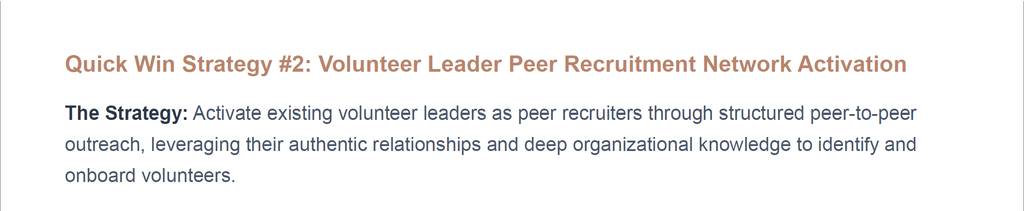
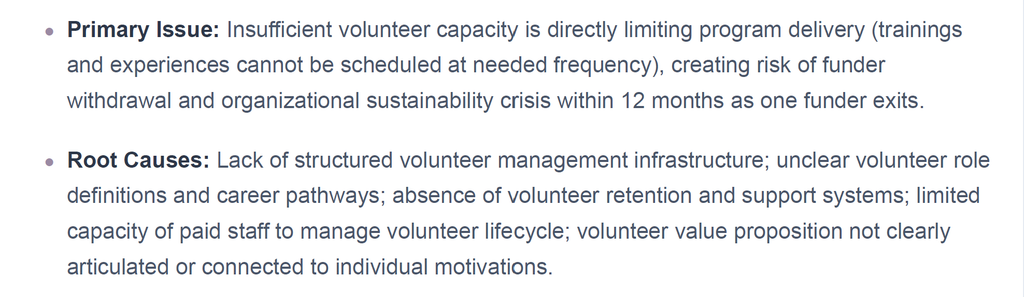
The Blueprint took her scenario and provided a full strategic analysis, including stakeholder analysis and strategy options for the sample organization. She noticed that several of the recommendations matched what she had already recommended to past clients.
“A lot of what she found in the report were things she had recommended before. It was aligned, and she appreciated that.”
What still needed here judgment
She was clear that this didn’t replace her judgment. Root-cause hypotheses and other analysis, she treated as things to verify with real people. She was clear on them being not conclusions to hand over as-is:
“As a consultant, would want to test the assumptions, such as the root cause and other analysis, such as landscape analysis, they were good but would want to test those by talking with people at the organization and community.”
And she named a boundary the tool simply could not do, understanding of a community’s specific social and cultural landscape:
“A landscape analysis isn’t something this can do. It depends on the social and cultural context of a specific community, which isn’t available as data. A consultant or the organization has to bring that in by focusing on their community.”
In the follow-up
She described how she would use it with a client:
Treat the report as a first draft, not a finished deliverable.
Test the assumptions with the client and add her own landscape analysis before presenting recommendations.
Position the hypothesis-heavy sections, like root cause, as starting points to test instead of conclusions.
What this means for a consultant
The trust question. For a consultant deciding whether to trust a tool like this, the key finding was that when she gave it a scenario built from real client patterns, much of what came back matched what she had already recommended to clients.
A second way to show up. The Blueprint gives a consultant a lighter way to work alongside her full engagements. With the intake and first-draft synthesis already done, she can offer a shorter, more focused kind of support: reviewing the draft with the client, testing its assumptions, and adding what only she can see.
Her time goes where her expertise matters.
Validating assumptions with the people closest to the problem
Adding local and cultural context the intake can’t capture
Facilitating alignment when a team is stuck
Building the relationship, which no report replaces
It fits smaller organizations, and orgs that want a different kind of help. Some orgs don’t need, or can’t take on, a long engagement. They need a thinking partner who can help them make sense of where they are. A shorter scope can mean a lower price and a rhythm that fits their capacity, with a few conversations over time instead of one large, front-loaded project.
It’s a first synthesis. The report is where the conversation starts. The consultant’s check is what turns it into something an organization can trust and act on. That’s what makes the combination work.
The Blueprint doesn’t replace the consultant’s expertise. It clears the groundwork so more of the engagement is spent on that expertise.