Organizational Blueprint – For consultants and coaches
Clear the groundwork. Spend your time where your expertise matters.
The Organizational Blueprint turns a client’s intake into a full first-draft analysis, with stakeholder analysis and strategy options. You review it with them, test the assumptions, and add what only you can see.
A second way to show up
The Blueprint gives you a lighter way to work alongside your full engagements. The intake and first-draft synthesis are already done, so you can offer shorter, more focused support.
Blueprint only
Can’t afford you, or not ready yet
They get a real implementation plan. You skip unpaid discovery time on a client who was never going to convert.
Blueprint + Conversation
A shorter scope
They run the Blueprint, then you review the draft with them, test its assumptions, and add what only you can see. A few conversations over time instead of one large, front-loaded project, which can mean a lower price and a rhythm that fits their capacity.
Full Engagement
Your kind of client
Your process, unchanged. Full discovery, full engagement.
A lot of what she found in the report were things she had recommended before. It was aligned, and she appreciated that.
Andrea, Social Impact Studio Consulting, independent consultant. She filled out the intake herself using a composite scenario drawn from patterns across her real client work, and used her own expertise as the benchmark. No real client data was used.
Where your time goes
The report is a first synthesis, and where the conversation starts. Your check is what turns it into something an organization can trust and act on.
Validate the assumptions
Root-cause hypotheses are starting points to test, not conclusions. You test them with the people closest to the problem.
Add local and cultural context
A community’s social and cultural landscape isn’t available as data. You or the organization bring it in.
Facilitate alignment
When a team is stuck, a report doesn’t move it. A facilitator does.
Build the relationship
No report replaces it.
Three tests, three different ways
Each one checked something different. All three landed in the same place.

A composite scenario, judged by an expert
An independent consultant ran a scenario built from patterns across her client work and used her own judgment as the benchmark. Several recommendations matched what she had already recommended.
“It was aligned, and she appreciated that.”

A decade-old policy study
Graduate research on senior SNAP enrollment took a full semester. The same root causes, run through the Blueprint, reached the same core interventions.

A youth violence prevention effort
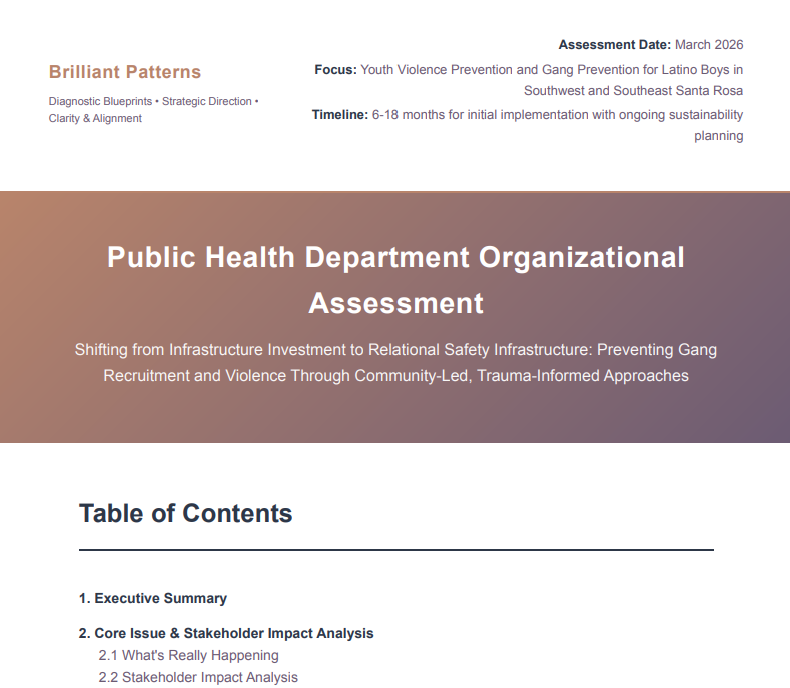
New buildings weren’t moving the numbers. One conversation reframed the problem and surfaced a funding source the team didn’t know existed.
What’s inside your Blueprint
Built from your answers and accounting for your whole self, you’ll get a development plan
8 strategies with implementation steps
Root cause of your challenges
Ideas for funding
Organizational strengths assessment
How it works
Find. Map. Blueprint
01 FIND
Work through the questions
1-2 hours on your on your own time. The questions are designed to surface what’s going on within your organization.
02 MAP
We analyze your responses
We find what’s blocking you and map a way through it — using your strengths, your environment, and what’s actually possible for your situation. The strategies come from your specific answers, not a profile type.
03 BLUEPRINT
Your Blueprint arrives in your email
A 70+ page organizational development plan, yours to work through on your own or bring into sessions with a coach, therapist, or mentor.
Are you ready?
Is Your Organization Ready for Self-Serve Diagnostic Assessment Work?
Before diving into deep organizational change, it helps to understand if your organization is positioned for success. Here is a checklist of conditions that make work effective.
→
People can be honest
Staff feel safe speaking truth about what’s working and what isn’t, without fear of retaliation or career consequences
→
Meetings show real engagement
When people are in a room together, they jump in with ideas and push back on each other, rather than sitting quietly or waiting for the leader to speak first
→
Leaders and staff see problems similarly
When you ask leadership “what’s our main challenge?” and ask frontline staff the same question, you get overlapping answers (not completely different perspectives)
→
Leadership is genuinely open to feedback
Leaders have demonstrated they can hear difficult truths and actually change course based on what they learn
→
You have basic systems in place
Not perfect, but functioning processes for how decisions get made and work gets done
→
You follow through
When your organization decides to change something, it tends to actually happen, not just get discussed
→
Staff can act without waiting for permission on everything
People have real latitude to exercise judgment and move things forward, not just execute top-down instructions
→
Adequate time and resources
Staff aren’t completely overwhelmed; you have or can access funding for assessment work
Are you an organization?
The Organizational Blueprint is currently available through consultants and coaches. Ask the consultant you work with, or contact us.
Try it on your next lead
Tell us about the organizations you can’t take on, and we’ll show you how the Blueprint fits.